Emissions

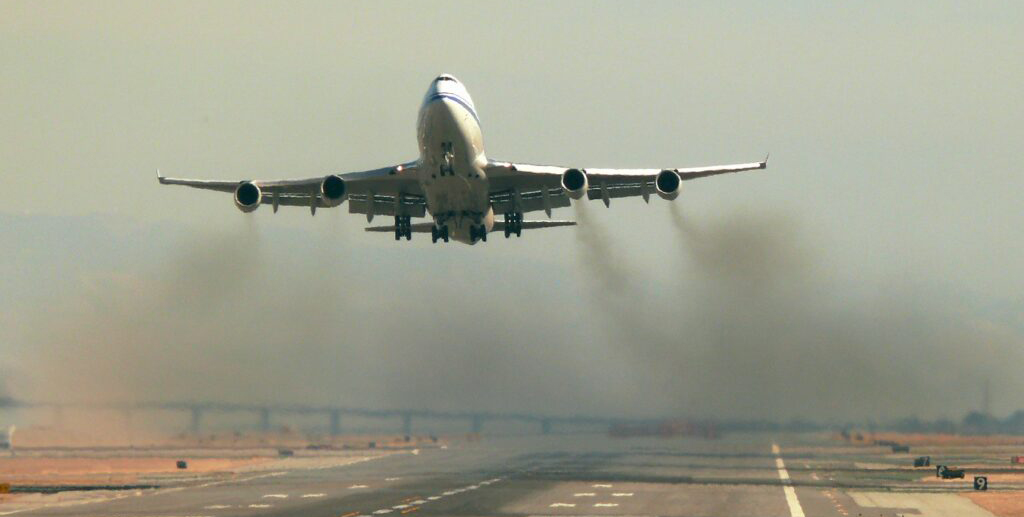
Aviation contributes to global warming through CO2 emissions and through the emission of other non-CO2 substances with a net warming effect. Anyone who takes a flight therefore contributes to global warming.
In addition to CO2, the combustion engine of an aircraft releases water vapour, nitrogen oxides (NOx), sulphur oxides (SOx), soot particles and hydrocarbons (HC). These non-CO2 emissions have a short atmospheric residence time. However, in that short time they change the chemical composition of the atmosphere and they cause changes in cloud cover. These changes disrupt the radiation balance of the earth (Effective Radiative Forcing, ERF): some of these processes caused by non-CO2 emissions cause a warming effect (a positive radiative forcing); some cause a cooling effect (a negative radiative forcing).
The net impact of non-CO2 emissions in aviation is a warming effect. However, quantification of radiative forcing (ERF), and thus quantification of the degree of warming/cooling on Earth, by these processes has large uncertainties.
The climate impact of non-CO2 emissions with a short atmospheric residence time is not linear with the combustion of fuel in the atmosphere, and therefore not linear with CO2 emissions. For example, an aircraft flying at high altitude has a smaller climate effect per kilometer due to CO2 emissions than when the same aircraft flies at low altitude. The climate effects of non-CO2 emissions show an opposite trend: an aircraft flying at high altitude has a larger climate effect per kilometer due to non-CO2 emissions than when the same aircraft flies at low altitude.
During taxiing and when flying low (such as in short-distance flights), non-CO2 emissions do not lead to climate effects. Aviation emissions have a relatively small share in total anthropogenic emissions compared to other anthropogenic sources. However, aviation emissions can have a relatively large climate impact, because aviation emissions at altitude have a greater impact on radiative forcing per kg of emissions than emissions from anthropogenic sources at the Earth’s surface.
Because the climate effect of non-CO2 emissions from air travel is large, Milieu Centraal proposes to include the climate impact of non-CO2 emissions in emission factors for aviation, despite the uncertainties in quantifying the climate impact of non-CO2 emissions: ignoring the climate impact of non-CO2 emissions would give an incomplete picture of the total contribution of air travel to global warming.
Ultrafine particles (UFPs) emitted from aircraft and ground support equipment at airports can pose health risks to nearby residents and airport workers. Studies have shown that exposure to UFPs, which are very small particles (less than 0.1 micrometer), can contribute to respiratory problems, cardiovascular issues, and other health concerns