Home » Key Issues » Medical community sounds alarm over aircraft emissions Medical community sounds alarm over aircraft emissions
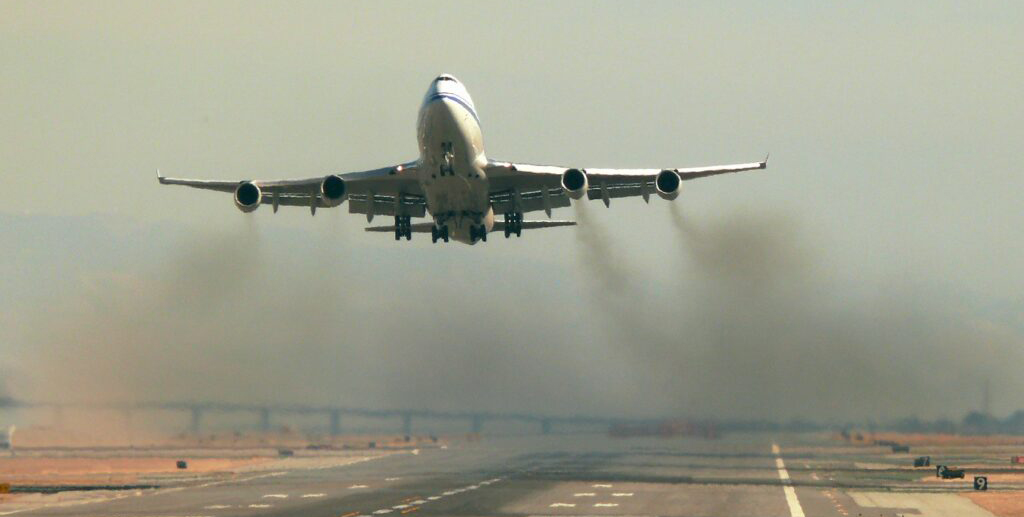
A new medical position paper from Germany exposes the severe health risks posed by ultrafine particles emitted from aircraft engines, contradicting the aviation industry’s claims of sustainable growth. These particles penetrate deep into human tissue, causing oxidative stress, inflammation, and DNA damage, leading to increased rates of lung, vascular, and cancer diseases near airports. Concentrations at airports are five to fifteen times higher than World Health Organization limits, reaching levels comparable to disaster zones, and these particles spread over 20 kilometers into residential areas, exposing 52 million Europeans to harmful levels.
The problem is structural and not technical: most emissions occur during taxiing when engines run inefficiently, releasing large amounts of unburned hydrocarbons. Aircraft engines cannot be filtered, and emissions correlate directly with kerosene consumption and flight frequency. Despite awareness, the industry and politicians maintain the myth of green flying, while medical science confirms ongoing daily harm.
The paper proposes concrete solutions: emission-free taxiing can be implemented immediately, and kerosene purification—costing one to two cents per liter—could reduce ultrafine particulate emissions by 30 to 50 percent. Most importantly, the aviation sector must abandon its growth path; a three percent annual reduction in slot issuance and an absolute CO₂ ceiling are necessary to structurally reduce emissions and health damage.
When health costs are factored in, the aviation industry’s economic claims collapse. External costs—including healthcare, climate, and environmental damage—amount to 13 cents per passenger kilometer, with domestic aviation causing 637 million euros in damage in 2024 alone. Meanwhile, the industry receives at least 12 billion euros annually in subsidies, creating a perverse system where profits are private but damages are public. Recent political rollbacks of climate measures further weaken protection efforts.
This document marks a tipping point, dismantling the illusion of sustainable aviation and framing ultrafine particulate pollution as a systematic health crisis affecting millions. While the problem is solvable, it requires politicians to prioritize public health over industry profits. Medical science has delivered its verdict: society must decide if it will accept an industry profiting at the expense of human health.