European Air Freight
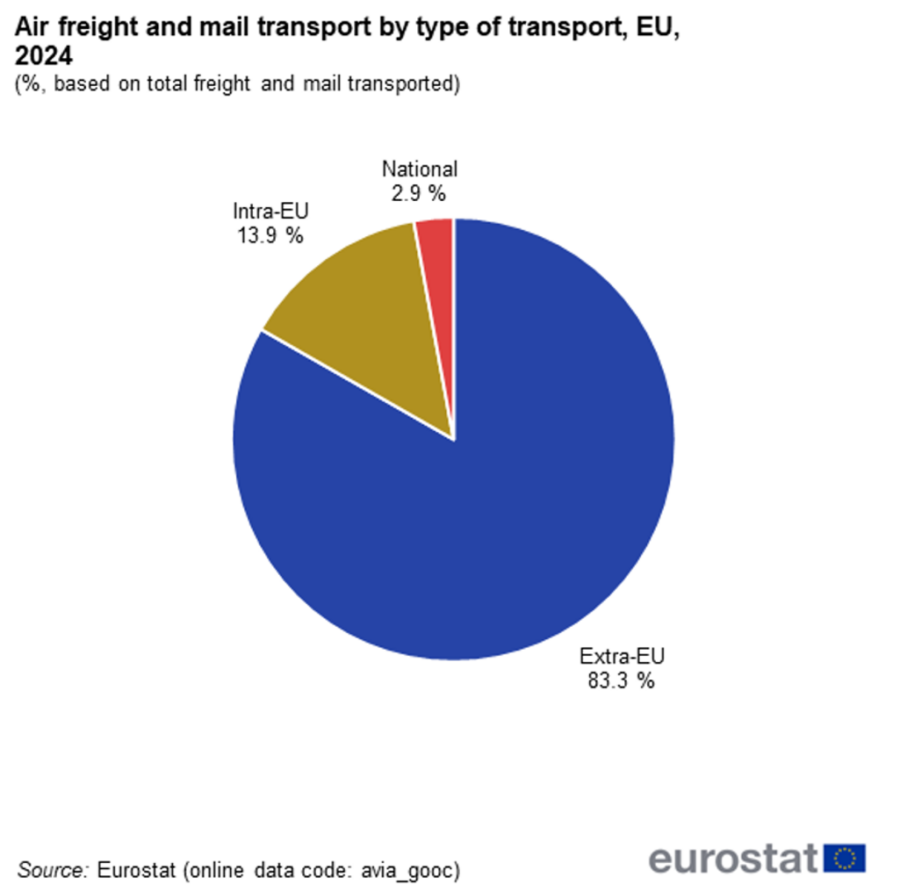
83% of the freight using European airports is from outside Europe. Intra-EU freight made up only 13.9% and national freight just 2.9%.
The role of air transport in freight transport is less significant than in passenger transport as air is expensive and only competitive with road and rail for longer distances and relatively light high-value or perishable goods.
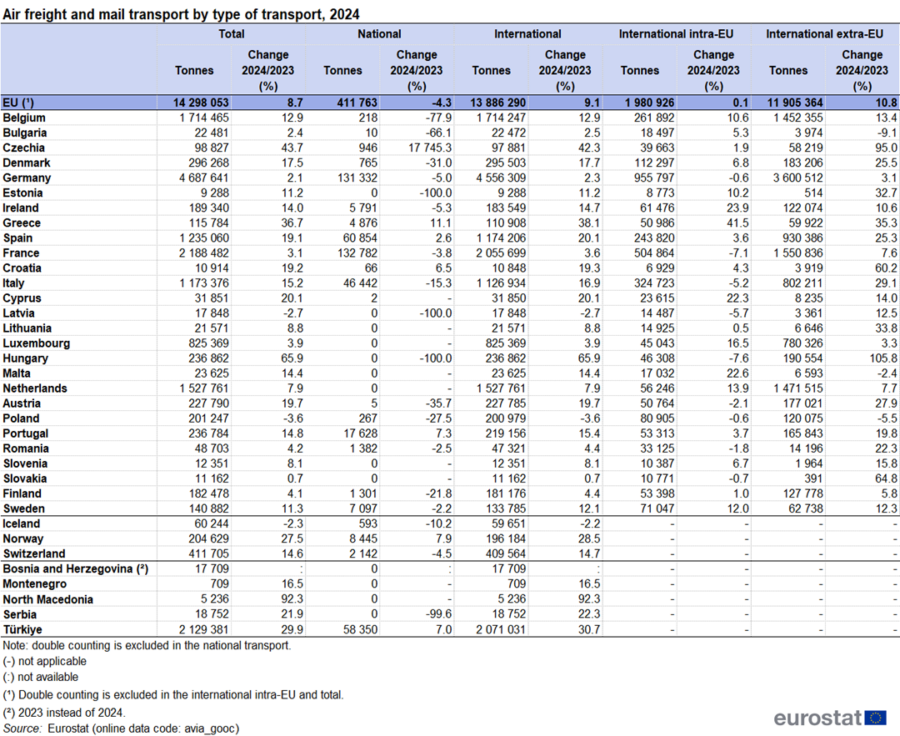
Nevertheless, total freight and mail transport in the EU increased by 8.7% in 2024 compared with 2023, reaching 14.3 million tonnes. This increase was mainly due to intra-EU transport which grew by 9.1%, while extra-EU was relatively stable (+0.1%). In contrast, national transport decreased by 4.3%.
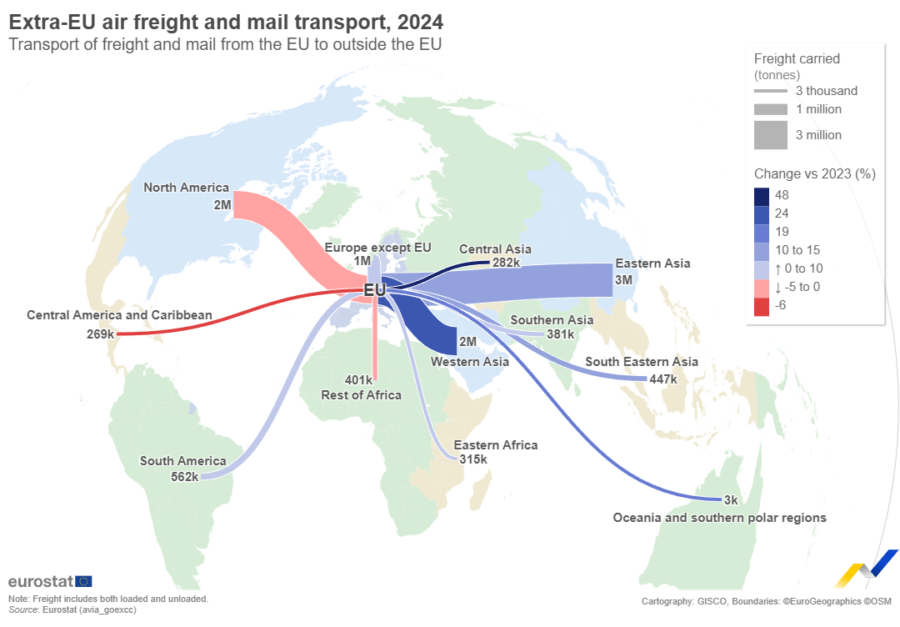
The American market dominates but the fastest-growing was the Asian market.
The highest volume of freight and mail was loaded and unloaded at German airports, with 4.7 million tonnes. Belgium, Spain, France, Italy, the Netherlands and Turkey were the other countries with more than 1 million tonnes of freight and mail. UK airports, not included in the table below, handled approximately 2.8 million tonnes of air freight in 2024.
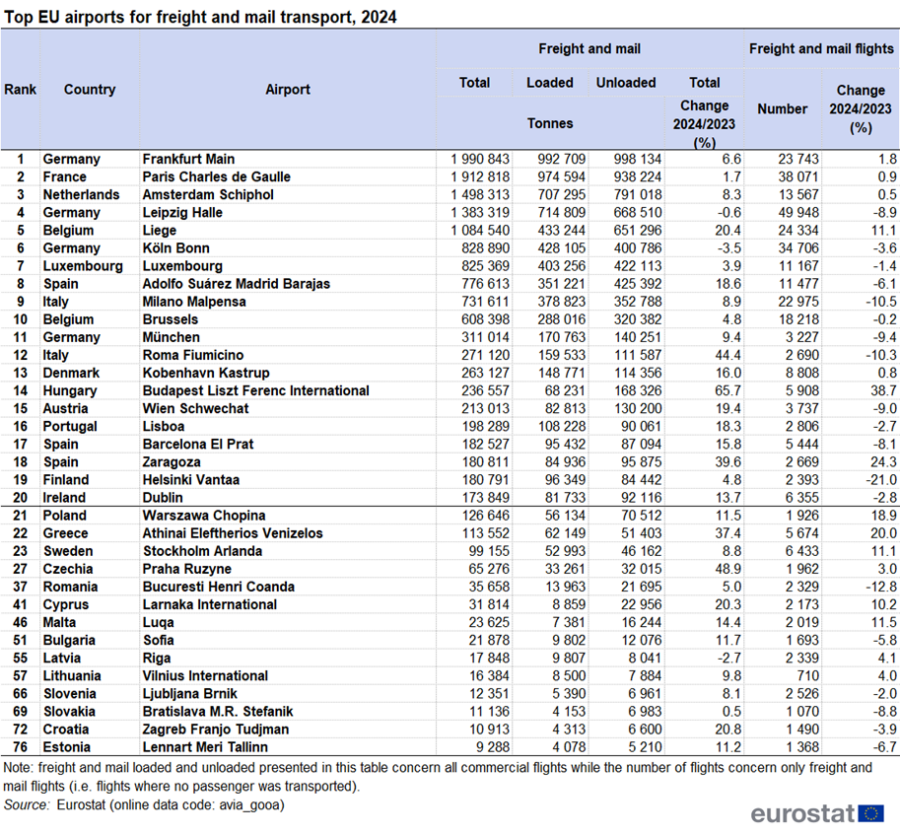 Frankfurt was the main EU airport for freight and mail, with 2.0 million tonnes. It was closely followed by Paris Charles de Gaulle, with 1.9 million tonnes. Amsterdam Schiphol, Leipzig Halle and Liege were the other EU airports with more than 1 million tonnes in 2024. Heathrow, if it had been included in the table would have been in 3rd place with 1.59 million tonnes of cargo,
When looking at the number of flights, the ranking was slightly different. Leipzig Halle was first with 49 948 flights, followed by Paris Charles de Gaulle (38 071 flights), Köln Bonn (34 706 flights), Liege (24 334 flights), Frankfurt Main (23 743 flights) and Milano Malpensa (22 975 flights). These were the only airports with more than 20 000 flights.
A main reason for this is, while major hubs like London Heathrow, Frankfurt, and Paris-CDG are highly reliant on belly-hold, specialist airports like Liège are driven by dedicated freighters. Overall belly-hold cargo capacity has continued to grow, accounting for roughly 55.5% of total international freight as of September 2025, with dedicated freighters taking the remainder.
At the specialist freight airports more than 40% of all-cargo flights in Europe operate between 11 p.m. and 7 a.m. While freighter aircraft represent only around 3% of total European traffic, they are heavily concentrated at night, particularly between midnight and 5 a.m. at around 25 key cargo-focused airports. (Eurocontrol, https://www.eurocontrol.int/archive_download/all/node/10576 )
Future trends
European air freight is entering a more complex phase, with modest demand growth offset by rising expectations around digitalisation, real-time visibility, and regulatory compliance. Competitive dynamics are shifting as airlines increasingly favour secondary hubs over congested mega-hubs, prioritising efficiency, resilience, and seamless data integration in response to geopolitical and supply chain risks. Vienna Airport exemplifies this trend, leveraging speed, strong Central and Eastern Europe connectivity, and continuous investment in digital and operational efficiency to position itself as a high-performance alternative, reflected in record cargo volumes and broad-based growth. Efficiency, compliance, and digital tools are no longer just nice-to-haves—they are now central to staying competitive. Customers expect real-time updates, electronic air waybills, and data-driven logistics, and those expectations are shaping how hubs operate across Europe. Michael Zach, Senior Vice President, Ground Handling and Cargo Operations at Vienna Airport, put it plainly: “We see digitalisation accelerating across the industry — real-time visibility, e-AWB, and data-driven decision-making are now expected by our customers and are no longer optional.
For more on this: https://aircargoweek.com/european-airfreight-finds-its-footing/
For more general reading: https://ec.europa.eu/eurostat/statistics-explained/index.php?title=Air_freight_transport_statistics
John Stewart May 2026
